
How Dalston Gardens Estate was renamed
In February 2025 Hackney Council agreed that the name of the Rhodes Estate, in Dalston, and its community hall should be changed to the Dalston Gardens Estate and Dalston Gardens Community Hall. This was based on the outcome of a resident-led consultation.
This article sets out why and how this name change came about and its context within Review, Rename and Reclaim.
How did the renaming process come about?
In June 2020, Hackney Council launched a review into place names and memorials to understand symbols of racist histories across Hackney’s public realm. Five names were identified, one of which was ‘Rhodes’, the others being Aske, Cass, Geffrye and Tyssen. Read about the context of Review, Rename & Reclaim.
The Tenant and Residents Association (TRA) for the Rhodes Estate, Dalston, had already been discussing concerns around their estate and community hall names and the potential associations with Cecil Rhodes and his problematic legacy in southern Africa.
The TRA requested support from Hackney Council to understand the local background to the Rhodes name, confirm whether or not it was connected to Cecil Rhodes’ imperial activities; and to support a consultation with its residents regarding a potential name change. This was managed through the Review, Rename and Reclaim programme.
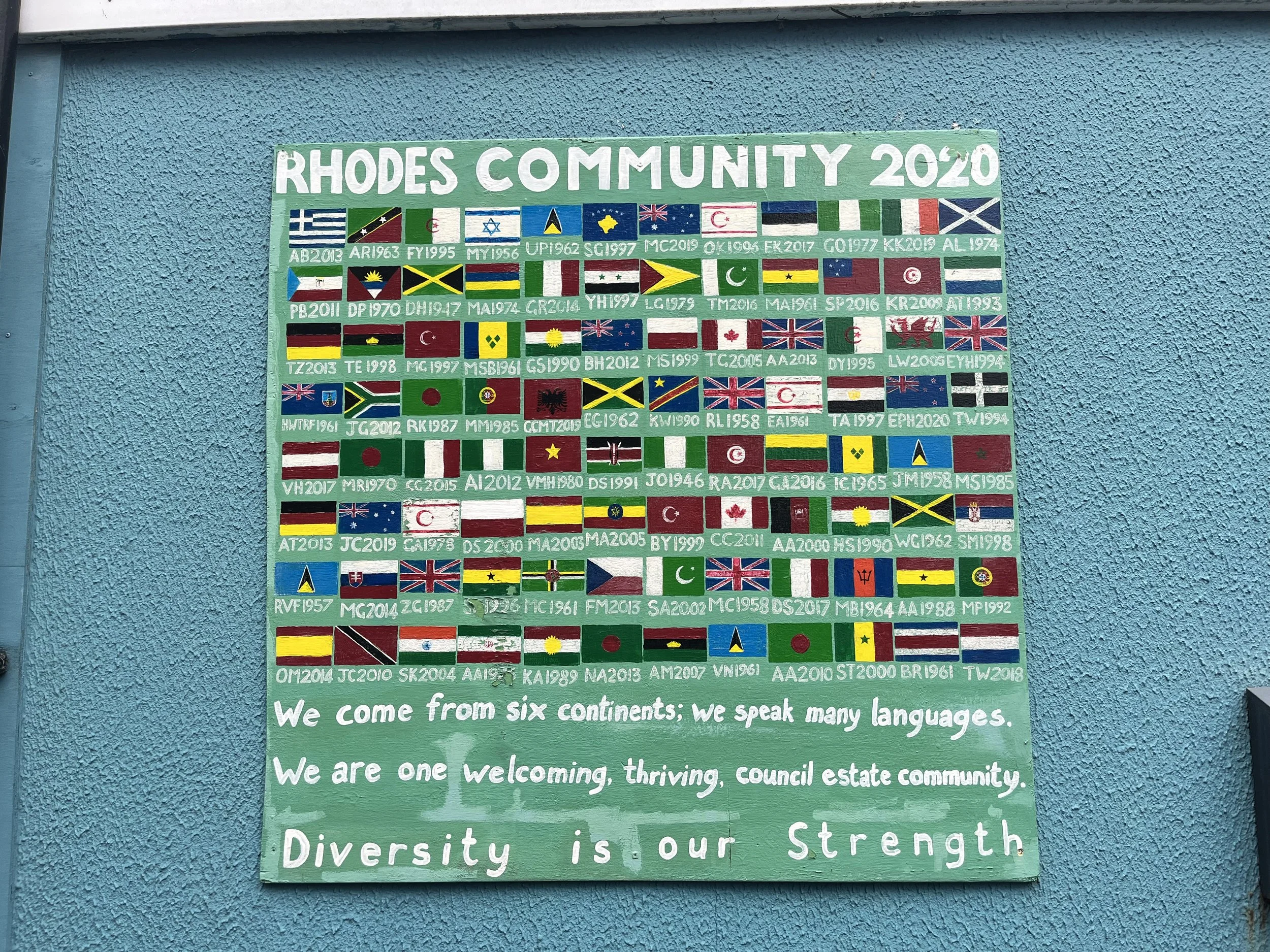
Illustrative board installed on the community hall in 2020, presenting the residents global representation, including the flag of South Africa.
Who was Cecil Rhodes and what was his connection to Dalston?
Over the years, the name ‘Rhodes’ in Dalston became primarily associated with Cecil John Rhodes (1853-1902) mainly due to his personal fame and wealth which enabled him to buy more of his family's inherited land - the land on which the current Dalston Gardens Estate is now built.
Cecil Rhodes oversaw the formation of Rhodesia in the early 1890s. The region was composed of the territories of Mashonaland and Matabeleland before colonial amalgamation. In the precolonial era, the region was part of several successive indigenous kingdoms including the Mutapa Empire and the Rozvi Empire. It is known today as Zimbabwe since gaining independence from colonial rule by the British in 1980. Rhodes was a founder of the British South Africa Company, an organisation established to promote colonisation and economic exploitation across much of southern and central Africa. He was outspoken in his belief that ‘Anglo-Saxon’ people were ‘the first race in the world’ and superior to people of African heritage.
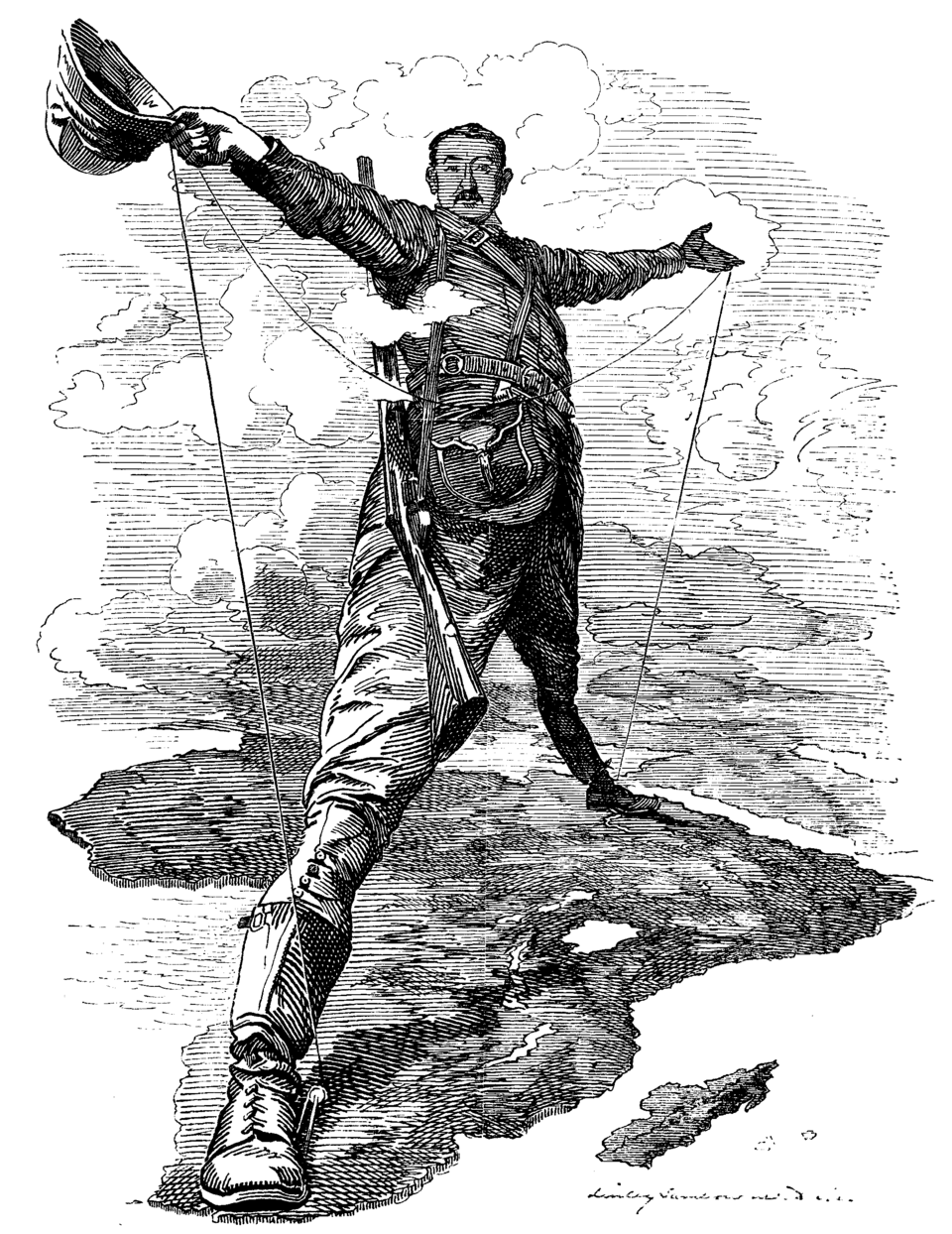
The Rhodes Colossus: Caricature of Cecil John Rhodes, after he announced plans for a telegraph line and railroad from Cape Town to Cairo. Credit: 10 December 1892 Punch and Exploring History 1400-1900: An anthology of primary sources, p. 401 by Rachel C. Gibbons
Cecil Rhodes’ family were initially farmers, settling on land in Hoxton during the 1700s. At this time the rural landscape was dominated by market gardens. Cecil’s great grandfather Samuel transitioned from farming to land speculation and brickmaking. He purchased the Lamb Farm Estate (between Kingsland Road and Dalston Lane) in 1788/9 with a view to developing it for housing.
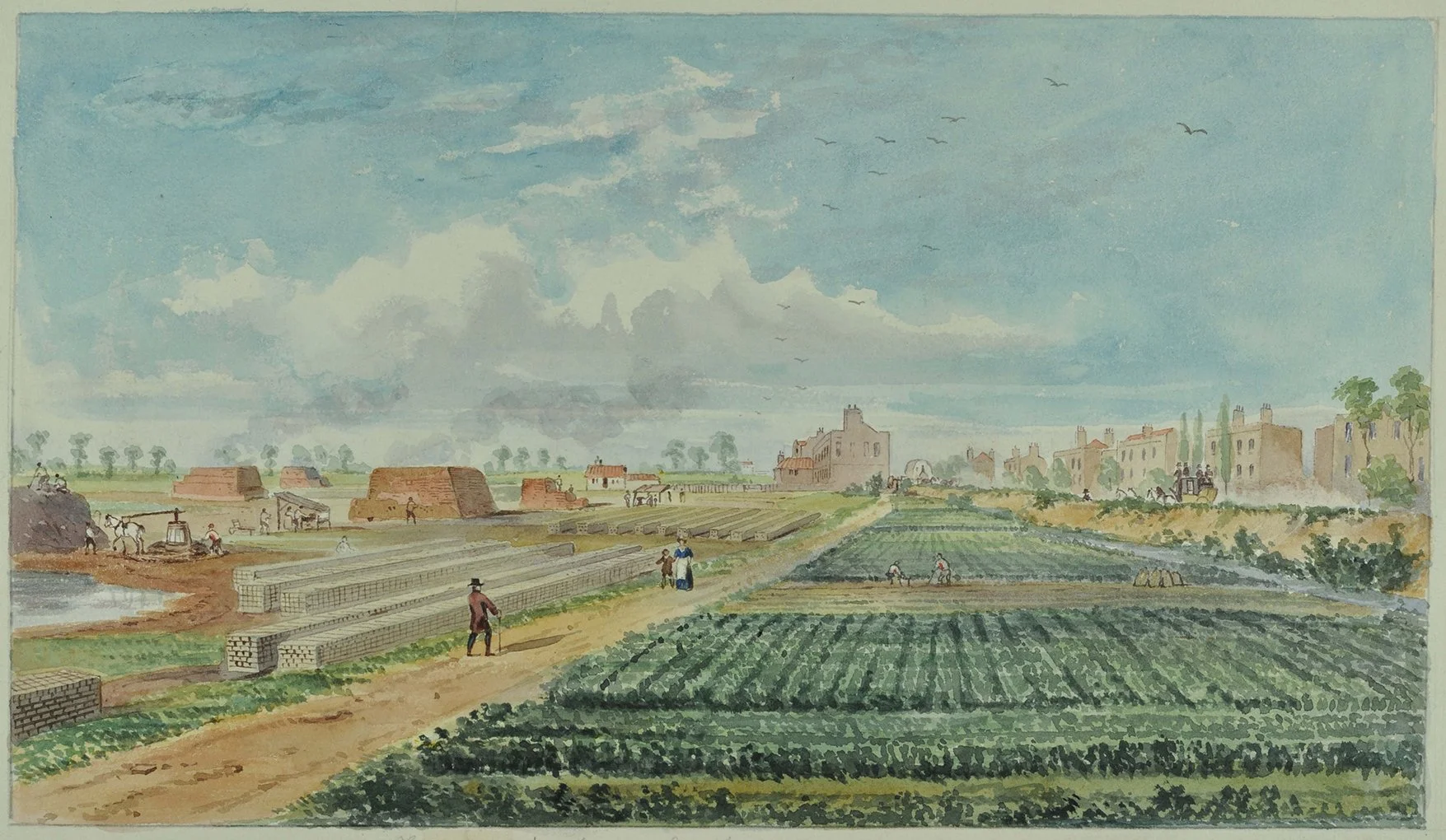
This watercolour of an area between Balls Pond Road and Kingsland Road (c1810) shows both the exploitation of the land for making brick (from local brick earth) alongside market gardens. Credit London Archives ref. 302827.
It was Samuel’s sons, one being Cecil’s grandfather, who succeeded in laying out streets and leasing land to builders on the Lamb Farm Estate. This process of planned urbanisation by the Rhodes family continued for four decades, securing inherited income for their heirs well into the 20th century. For a full history on the Rhodes family in the area refer to Sean Gubbins, Rhodes Town - How Lamb Farm became Hackney suburbia (2014) available in Hackney Archives.
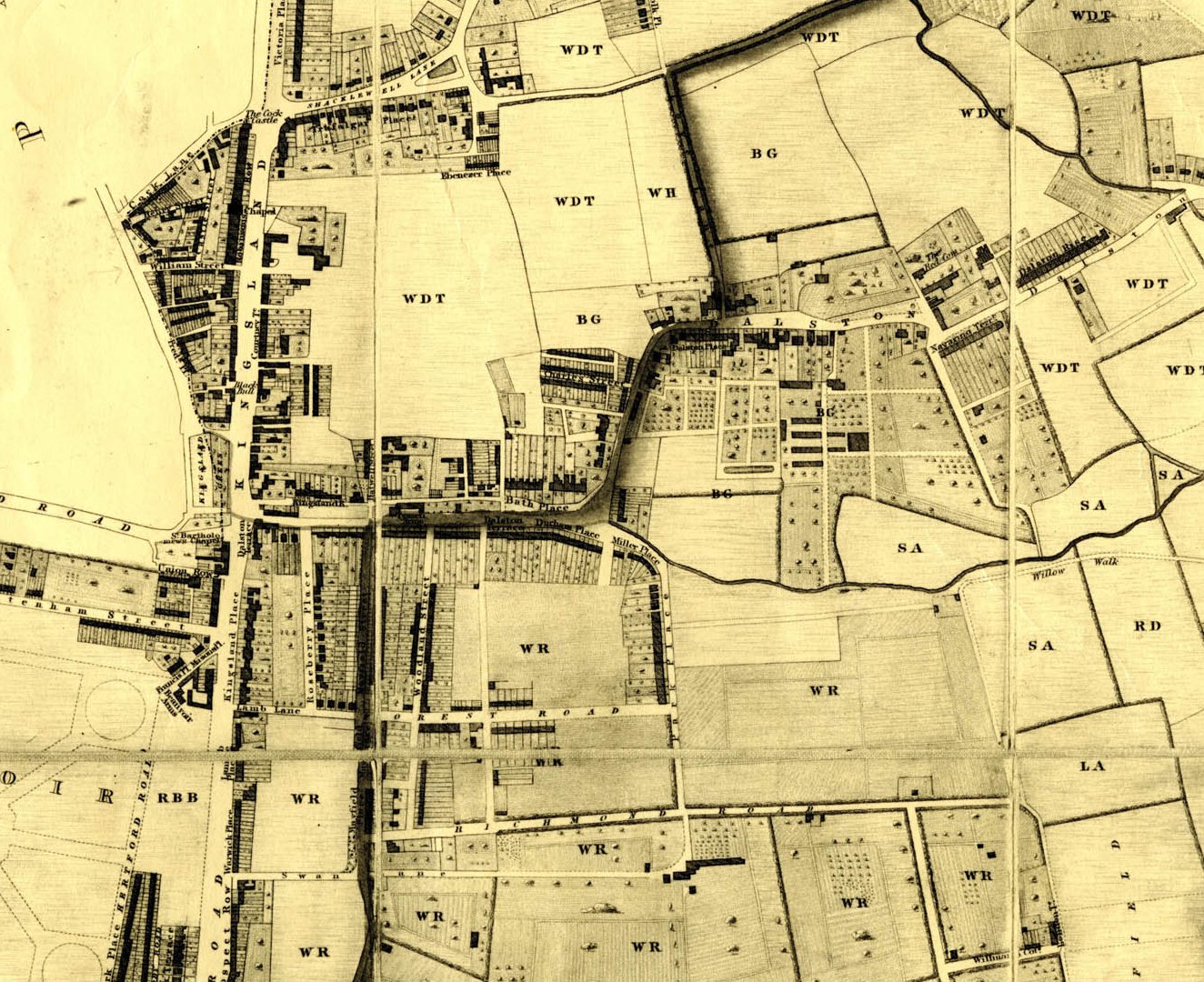
Starling Map of 1831 - in the centre is land belonging to William Rhodes (WR), (Cecil’s grandfather). By this time properties are built along laid out road. Forest Road and Richmond Road survive today.
Whilst still a teenager Cecil Rhodes followed his brother to Africa, and soon made high returns in diamond mining. Although Cecil was not born in Hackney, nor lived here, he did develop an association with it once he inherited a share in the Dalston land, on this father’s death in 1878.
Just a few years after inheriting his father’s portion of the Lamb Farm Estate, Cecil Rhodes considered standing as a Member of Parliament for Hackney Central, the constituency in which the Dalston estate was located, at that time.
Due to his wealth Cecil was able to buy more of the Dalston estate from his cousins, growing his land ownership in the area. On his death it was this Dalston land that was again managed in trust for the benefit of his relations (as he had no children of his own).
Due to his fame and wealth Cecil's name became synonymous with the Dalston estate particularly in the local press or when philanthropic donations were sought to support local needs.
In 1959 Hackney Borough Council purchased the Rhodes Trust Estate, (this collection of records is available to view at Hackney Archives). The land now covered around 12 acres between Richmond Road and Middleton Road, to the west of Queensbridge Road. The London County Council (later Greater London Council) had also purchased almost 19 acres of the neighbouring vicinity of Forest Road. The plan was to redevelop the area by compulsory purchasing and demolishing the nineteenth century housing stock. This was completed in the 1970s with many of the remaining residents moving into the nearby Holly Street Estate (built between 1966-1971). The Rhodes Estate was completed between 1975-1978. Some of the original 19th century housing stock does survive along the east side of Queensbridge Road.
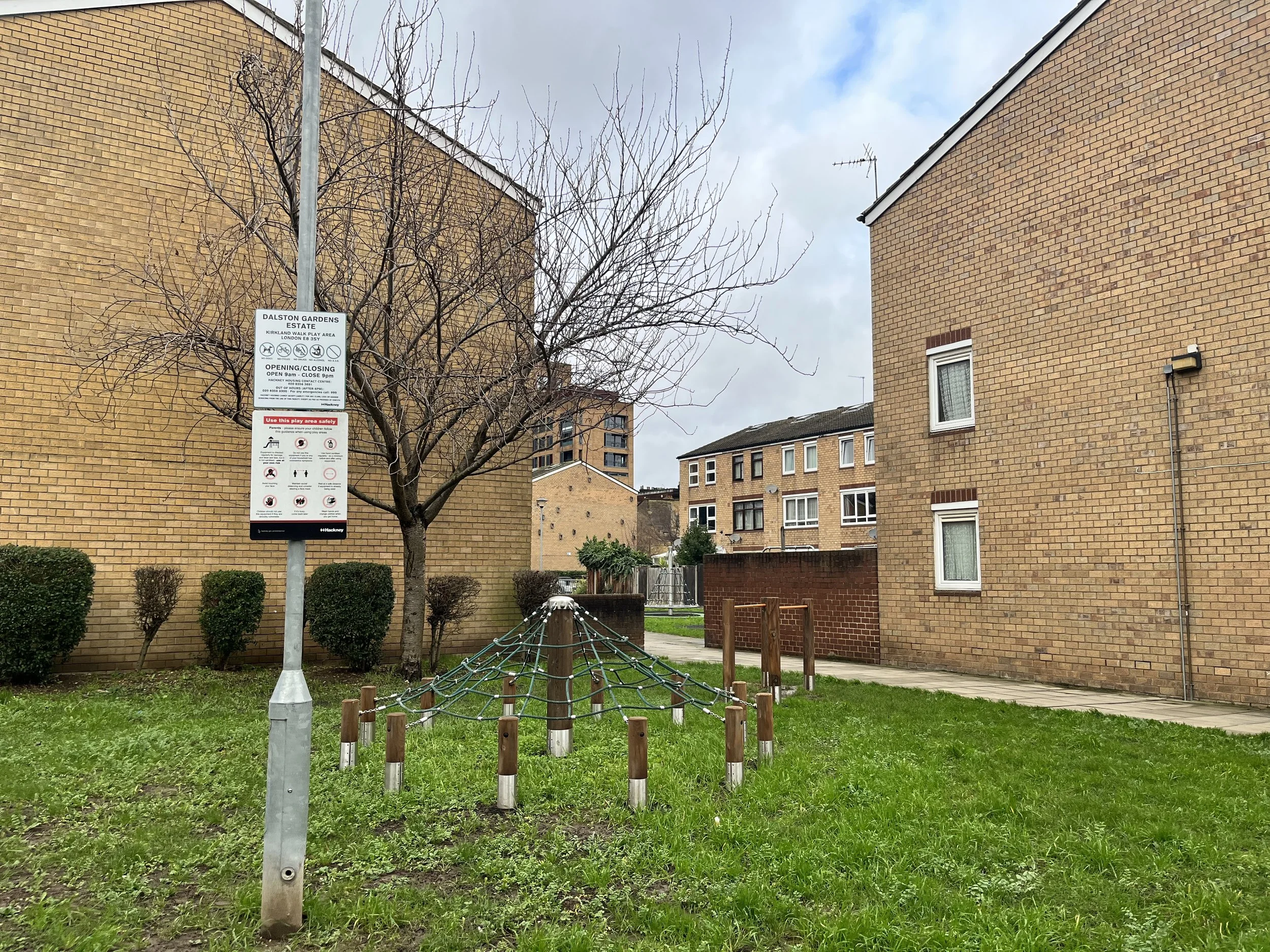
The 1970s estate was laid out with green spaces. Today these provide much needed space for play and community gardening. View through the estate, 2026.
Resident-led consultation
Renaming the Rhodes Estate in Dalston took a resident-led approach.
The first step was to consult with residents to seek a majority opinion to either retain the name or remove the name ‘Rhodes’. This consultation included an information sheet on Cecil Rhodes, his connection to the Dalston and land on which the housing estate was built and his racist legacy in Southern Africa. It also sought opinions on the type of name to replace it. Residents were also asked how they would like to engage in the process and a list of names (from the Naming Hub) for comment.
The outcome of this first consultation engaged over 50% of households, of which 63% wanted the name changed. Other data collected informed the design of a second consultation, including a community event to gather feedback on a long list of suggested names. This informed a resident working group to create a final shortlist of names.
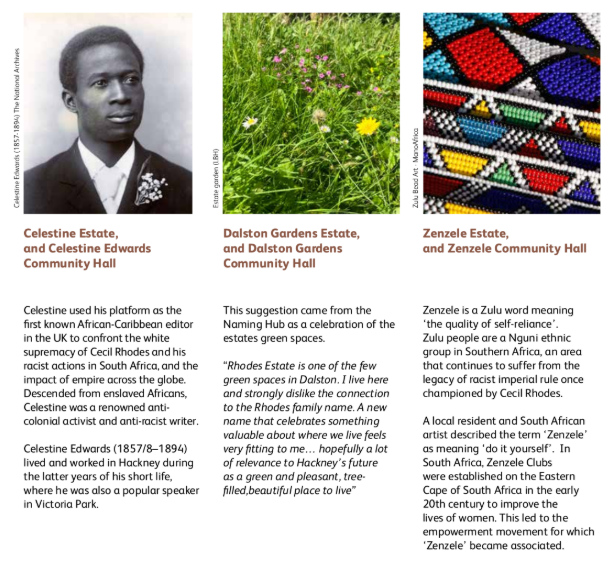
Three names went out to residents to vote for their preferred name. 103 residents participated directly with the survey with 76% choosing ‘Dalston Gardens Estate’.
The outcome of this process was reported to Full Council in February 2025, with the recommendation to accept the outcome of the resident consultations and to rename the estate and community hall. This was agreed and the name change took effect from April 2025.
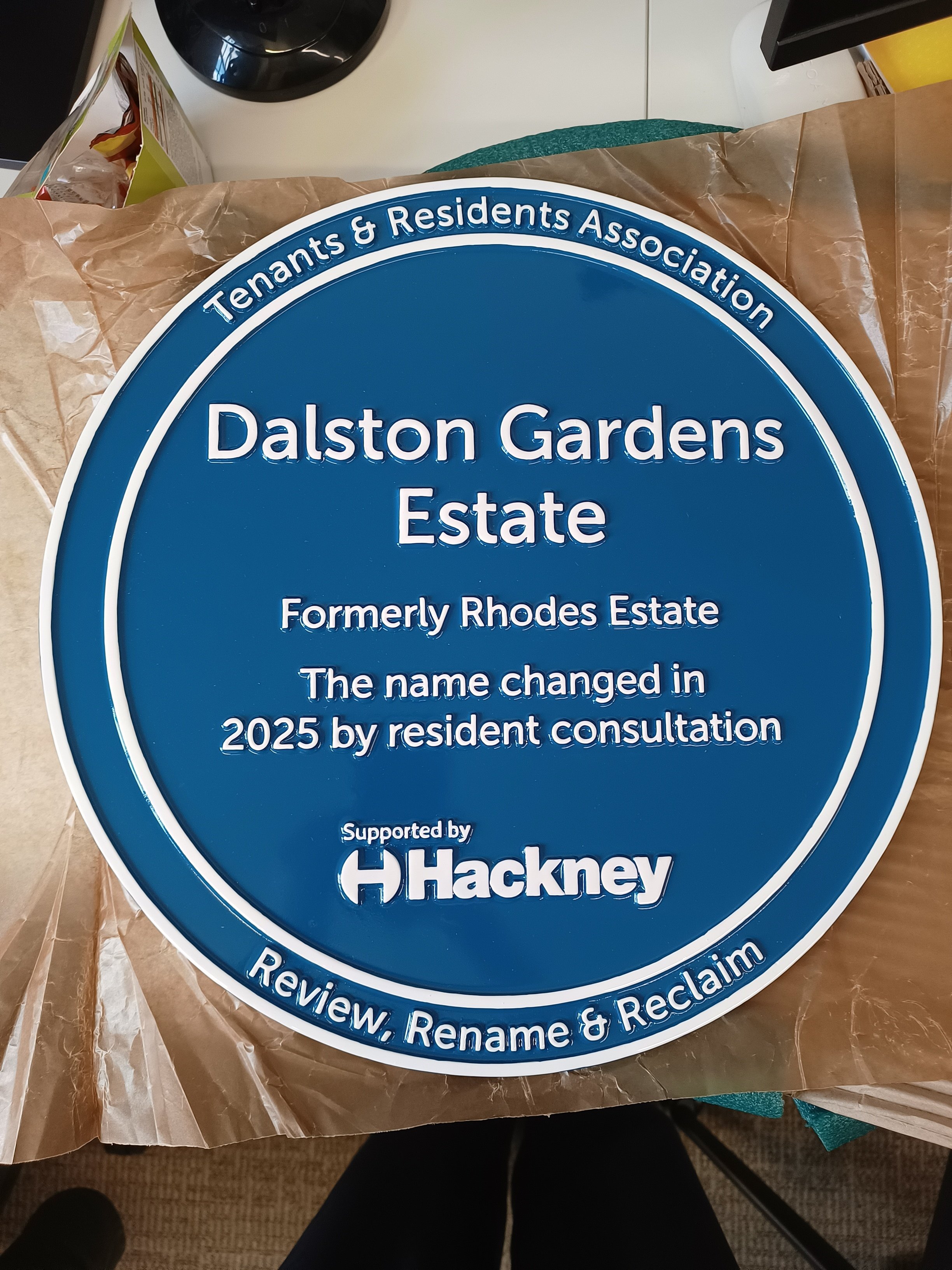
Image of the plaque, installed on Dalston Gardens Community Hall, July 2026.