
Hackney Archives is home to the borough’s radical local newspapers, reflecting the pivotal role they played in grassroots activism against social hardship in Hackney from 1969 to 1985.
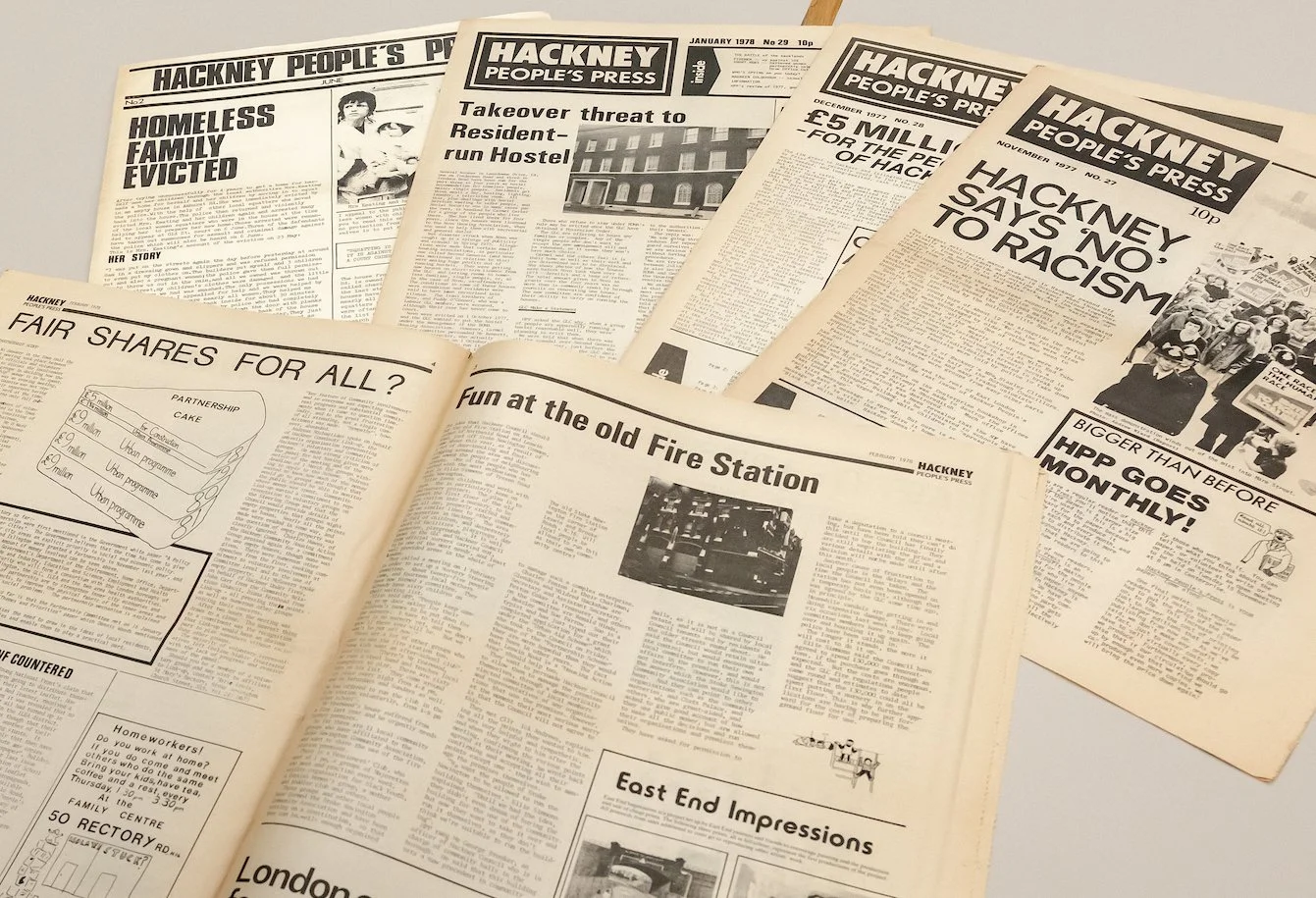
The Hackney People’s Press (HPP) operated between 1973 and 1985. It was a dynamic Hackney-based community newspaper that covered local and national issues through turbulent 12 years, from energy shortages to funding cuts to public services, national strikes and nuclear threat.
The paper was an amalgamation of two earlier radical newspapers - Hackney Gutter Press and Hackney Action, both of which are also available to view at Hackney Archives.
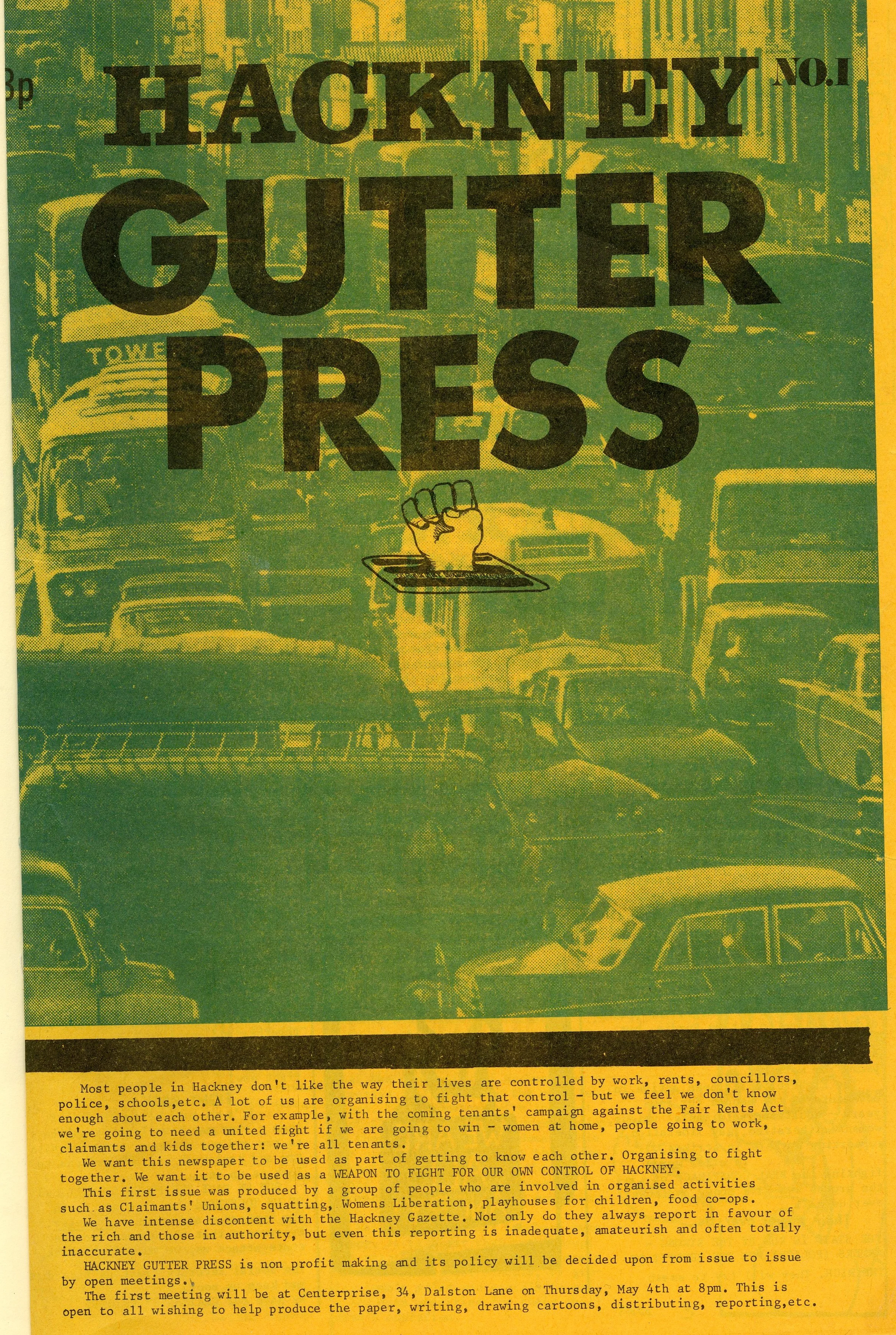
Established in 1969, the Hackney Gutter Press was an early alternative newspaper in London. It represented a broad libertarian movement including claimants’ unions, women’s groups, and food co-operatives.
Hackney Action was founded in June 1972 by Centerprise, the radical community centre, bookshop and coffee bar, based in Dalston. It focused more on community issues, such as the lack of decent childcare, housing and education.
The merger of these two papers brought together resources and energies, with the goal of enabling regular monthly publication of the new paper. From its debut in May 1973, the HPP was broadly on the left, although it was independent of political parties and groups.
The paper covered local issues such as policing and housing. It generated funds through events, such as concerts at Chats Palace, and occasional donations.
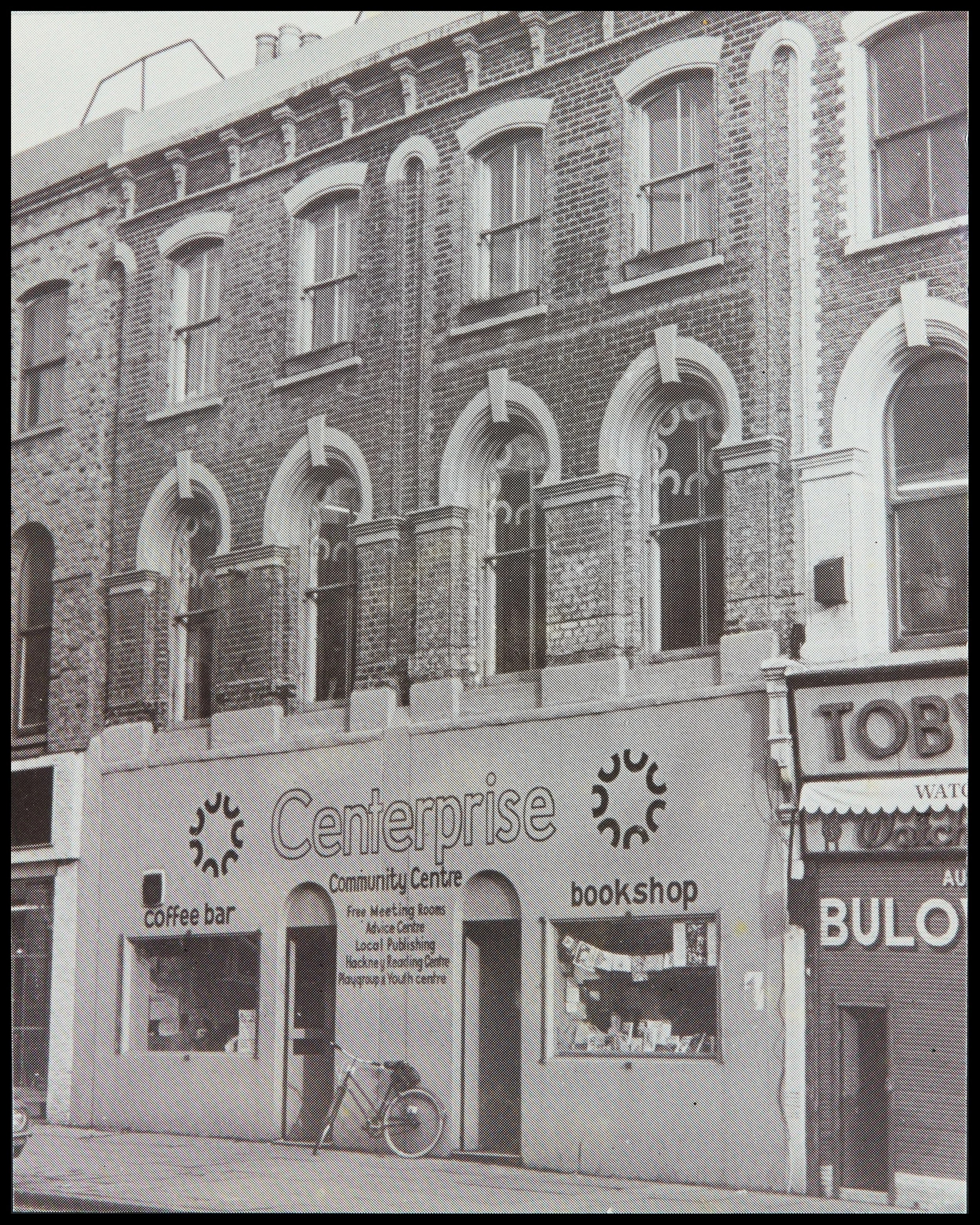
Centerprise on Kingsland Road, Dalston c.1980 [Hackney Archives D/B/HPP/E/02/054].
Crispin Aubrey was part of the collective that produced the first issue of the Hackney People’s Press. In November 1979 he reflected in Issue 50
““What those early HPPs were trying to do, was to give an alternative voice to all the different struggles going on in the borough, from housing to work conditions, as well as publicising the sort of fringe events which rarely got mentioned in the Hackney Gazette”. ”
All aspects of producing the paper, except the printing itself, were covered by volunteers.
Initially introduced to the publication by a friend, Charles Foster became involved in production and layout, and later contributing to writing. In an interview with Hackney Archives he described the traditional ‘paste-up’ production as laborious, often taking an entire weekend to produce.
This work often took place in the offices of Centerprise, or later Trojan Press, a printing company established by former HPP contributors.
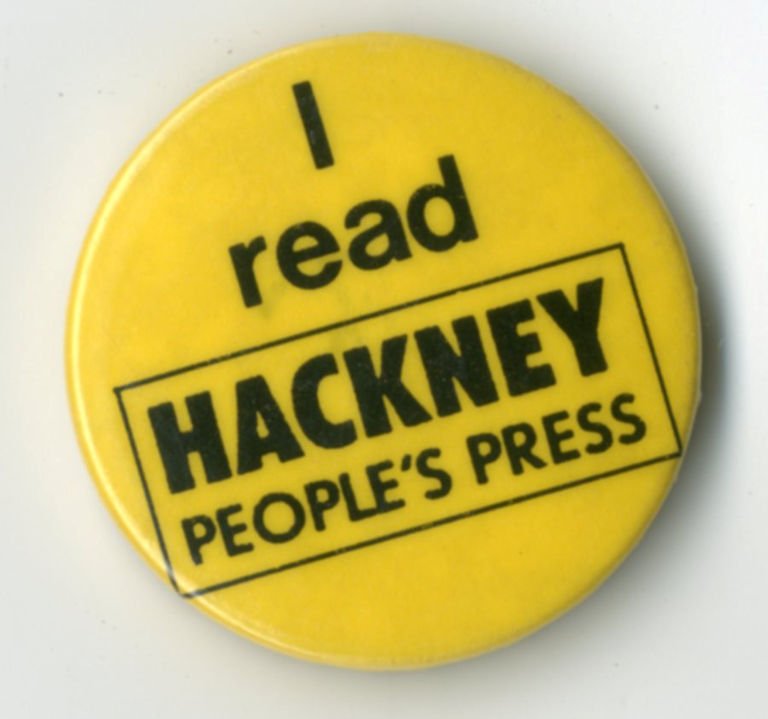
Fundraising badge, from Hackney Museum collection [2013.213]
Readers were invited to get involved in putting the paper together by attending an open editorial meeting. Involvement could take the form of writing articles, helping with the layout, or distribution such as selling copies of the paper.
The callout describes the paper as follows: “Hackney People’s Press is an alternative non-profit making monthly newspaper produced by an open group of people who live or work in Hackney. We publish the paper because we believe that Hackney needs an alternative to the commercial press to serve the real interests of its people. We have no editor and no shareholders, and no one is paid by the paper.”
Political backdrop
The Hackney Gutter Press, Hackney Action and Hackney People’s Press covers a period of great change and instability from cold war politics and threat of nuclear war and increasing campaign for nuclear disarmament, to the free market politics of Prime Minister Margaret Thatcher from 1979, and Conservative policies that reduced high taxation to withdraw state funding and welfare spending. Free market politics brought a rapid end to the declining manufacturing industries and a rise in unemployment across the nation, which was to hit Hackney and many towns and cities across the nation.

Preparations for the Hackney Peace Carnival and its anti-nuclear message, outside the Town Hall, 1983 . The Town Hall banner states the number of unemployed, as part of the local Labour Party campaign highlighting the impact of national political policies. [Copyright Walker estate, D/F/WAL]
An article in the Dec 83/Jan 84 issue (read the full edition here) compared conditions in Hackney to George Orwell’s novel ‘1984’. It read:
““Everyday life in Hackney may not be as dramatic in 1984 as Orwell’s imaginary world, but the present Conservative government is doing as much as it can to increase misery in the borough. It feels as though we’ve been living in 1984 for the last four and a half years.””
During this period the paper increased its focus on both local and national politics. However, production became less consistent and the paper abruptly ceased production after June 1985.
Today researchers can find evidence of community campaigns that once again feel relevant in our own turbulent times including anti-racism activity, communities taking back control of their environment and spaces, housing maintenance and the cost of living. At the heart of each edition is the agency of local people taking part in local and nationwide campaigns to be heard as they seek change and betterment.
Hackney Archives holds a complete collection of the Hackney People’s Press, and has now digitised almost 700 photographs from the HPP collection, which you can now search and view online. This is alongside extensive records from the paper’s operations, including hundreds of photographs, as well as the Hackney Gutter Press (1969) and Hackney Action (1972).
To request to see this collection in person, first register an account online this allows you to save searches and request items from the store. On your first visit please bring proof of address to complete your registration process.
Staff are currently working on adding all digitized copies of our radical press collection onto the catalogue for online viewing.
Find out more about Hackney Archives and its historic collections and how to plan your visit.